
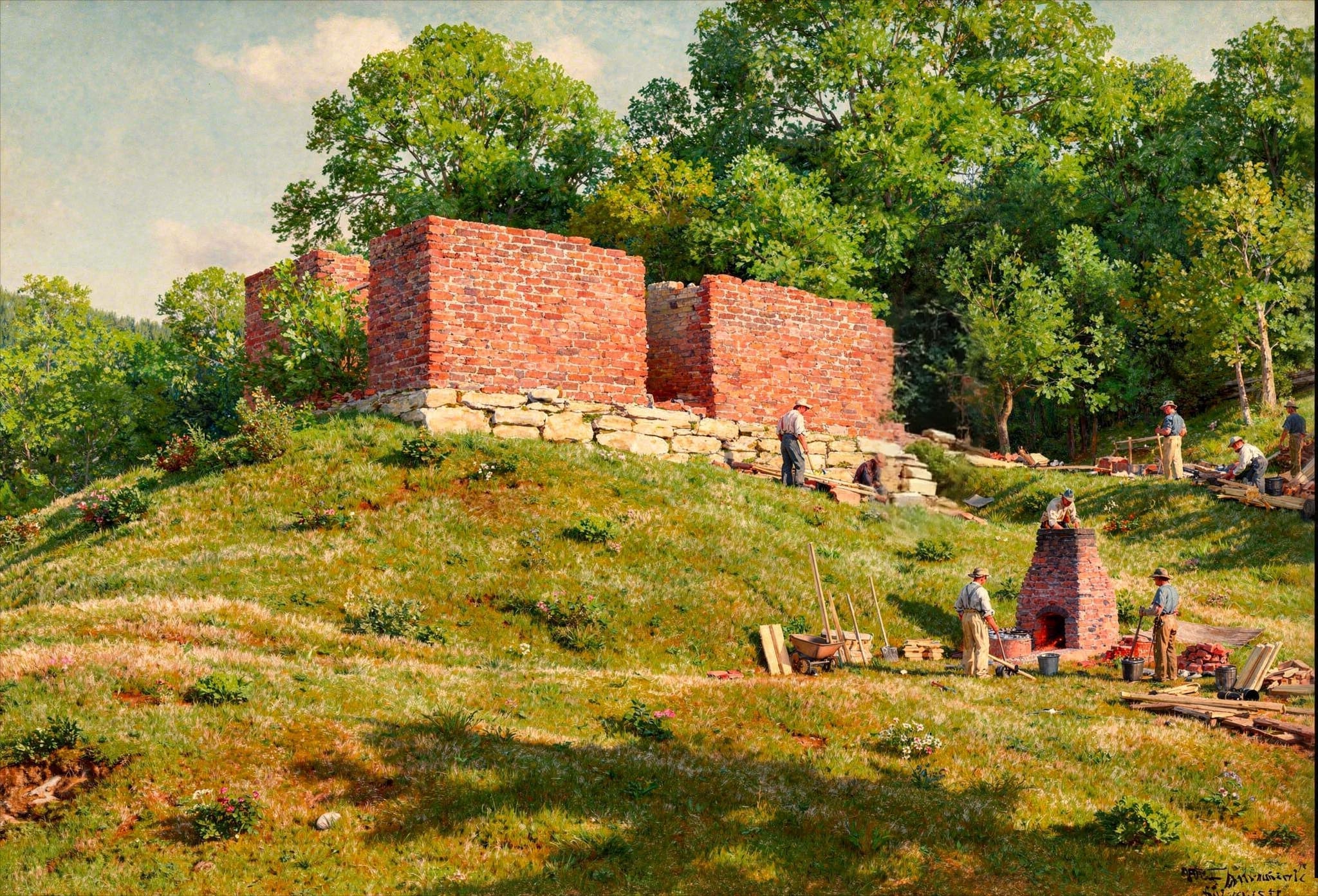
By the time Henry Bradford settled on Drake’s Creek in Sumner County around 1794, he had already survived more than most men would face in a lifetime. A fatherless childhood in Virginia. The Revolutionary War. A wound at Brandywine. A deadly ambush on the Wilderness Road. But Henry Bradford was not a man who simply survived—he was a man who built.
One of his first acts in Sumner County was to help build a stockade for the settlement’s defense. Then he turned to his own home. He sent back to Virginia to borrow enslaved people from his step-father, William Nash. They made brick on-site to build the Bradford house—a structure with a massive native rock foundation, a large basement, and brick walls two feet thick. It was the first brick home built in the area, and it was built to last centuries.
The house was named Hazel Patch—or Hazelpatch—in memory of the place where Bradford’s party had been attacked by Indians on the Wilderness Road. It would later be known as the Bradford House, the Priestley-Bradford House, Darlington Place, and finally the Bradford-Berry House. Under any name, it was a landmark.
Bradford quickly became one of the most prominent citizens in the region. In 1795, the federal government began collecting excise taxes in the territory, and Henry was named one of three collectors—alongside Robert Houston and Colonel Baldwin Harle. The tax covered 450 distilleries, plus levies on wine, tea, refined sugar, carriages, snuff, and licenses for auctioneers and realtors. Bradford served as collector under both Presidents Adams and Jefferson. His handmade leather-bound record book of stills and their owners remains in the Bradford family’s possession to this day.
In 1796, Bradford was named a trustee by the General Assembly of Tennessee to decide on a county seat location, purchase land, and erect a courthouse, prison, and stocks. The town was to be named “Ca Ira,” later “Cairo.” That act was repealed, and the town finally became Gallatin—named for Albert Gallatin, the permanent county seat of Sumner County.
Bradford was also appointed Brigade Major for the militia in the Mero District in 1791—one of the two districts that would become the state of Tennessee in 1796. That same year, he traveled to Wautauga to negotiate a treaty with the Indians, having signed a letter from the Mero District officers to President Washington pleading for protection.
In 1806, he was named a trustee of Transmontania Academy for Boys, Gallatin’s first charter school. His fellow trustees included James Winchester, David Shelby, Edward Douglass, and William Montgomery—names that still echo through Tennessee history.
Henry Bradford’s children grew up in the house he built. His daughter Cecelia married William Carroll on September 1, 1813—a lavish wedding recorded in Sumner County. Carroll would serve as the fifth Governor of Tennessee for a record six terms. His son Larkin became a lieutenant and was killed at the Battle of Talladega in 1813, serving under Andrew Jackson. His son Priestly operated the first store in the area, in a brick building east of Drakes Creek.
Henry C. Bradford died in July 1815, at the age of 57. He was buried in the family cemetery on his property near what is now Hendersonville. His grave was later marked on September 30, 1973, by the French Lick Chapter of the DAR. The house he built—the house that sheltered a war hero, a tax collector, a militia commander, and the father-in-law of a governor—still stands.
Frequently Asked Questions
What was Hazel Patch?
Hazel Patch was the name Henry Bradford gave his homestead on Drake’s Creek in present-day Sumner County, Tennessee; the brick house later became known as the Bradford-Berry House.
Was the Bradford-Berry House the first brick home in the area?
Yes. Henry Bradford’s homestead, built around 1794 with brick fired on-site, is regarded as the first brick home in the area that became Hendersonville, Tennessee.
What was Henry Bradford’s role as a tax collector?
In 1795, Henry Bradford was named one of three federal excise tax collectors for the region, overseeing some 450 distilleries and other levies under Presidents Adams and Jefferson.
How is Henry Bradford connected to a Tennessee governor?
Henry Bradford’s daughter Cecelia married William Carroll in 1813; Carroll went on to serve six terms as the fifth Governor of Tennessee.


