
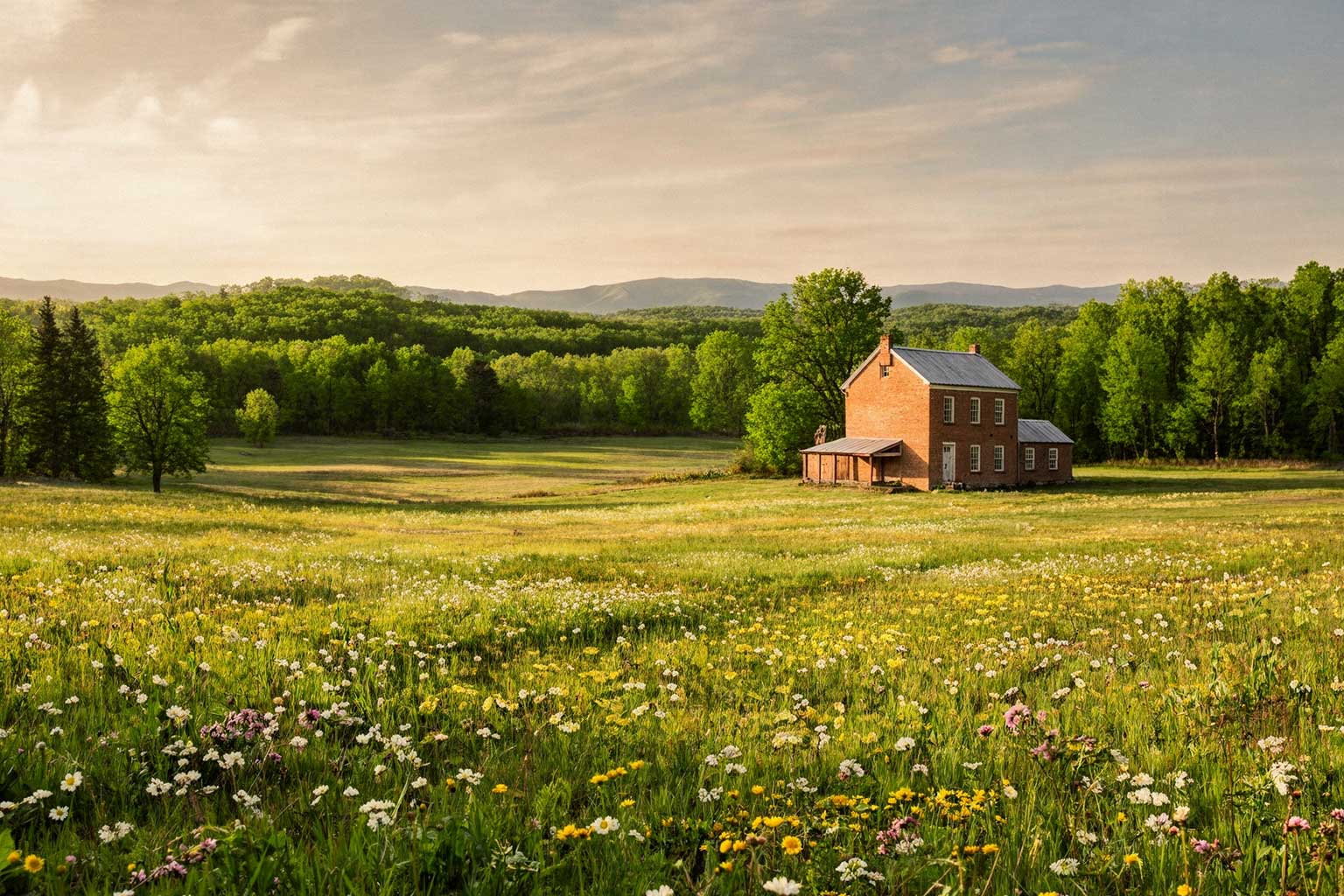
Bradford. Priestley. Willis. Berry. General Electric. The Arts Council. HTPC. The City. Eight names, two and a half centuries, one set of two-foot brick walls—and the long quiet conversation between everyone who decided this place was worth keeping.
Most houses pass quietly from one family to the next. Deeds get recorded. Keys get handed over. The new owner repaints the kitchen and the building keeps doing what it has always done.
The Bradford-Berry House has not had a quiet life.
In the more than two centuries since Henry Bradford laid the first brick on Drake’s Creek, the property has changed hands at least seven times. Each owner inherited a structure that was already old. Each one wrote something into the building’s story. Some added wings. Some installed elevators. Some let the place fall into the kind of slow decline that always looks survivable until suddenly it does not. June is National Homeownership Month, and we are going to spend it tracing this chain of ownership in full. Today is the preview.
It begins with a land bounty.
Henry Bradford received roughly 1,000 acres in what is now Sumner County in payment for his Revolutionary War service. He came west in the fall of 1784, survived an ambush along the Wilderness Road, settled on Drake’s Creek by 1794, and built the brick house using clay fired on the property and labor borrowed from his stepfather in Virginia. He named the place Hazel Patch in memory of the attack. He lived there until he died in 1815, and his widow Elizabeth lived there until her death in 1839.
After Elizabeth, the building entered a more complicated phase. The Bradford children scattered — to Mississippi, Arkansas, Pittsburgh, Nashville. The Priestley family is associated with the property in the early-to-mid 1800s. So is the Willis family, whose graves are still in the yard. Stephen G. Willis died there in 1861. The exact transitions between these owners are still being mapped from county deed records, and we will be doing that mapping in June.
Then came the Berrys.
In 1887, Horatio Berry — a Nashville banker and son of one of the city’s most prominent businessmen — bought the Bradford homestead and several hundred surrounding acres. The purchase was a baby gift. His daughter Sarah Crosby Berry had just been born, and the property was, in effect, a deed in her name. Sarah lived most of her life at Hazel Path Mansion, the Berry family’s primary residence, but she did renovate the Bradford house with the intention of moving in. She added a garage. She added a kitchen wing. She installed an elevator. She never made the move. She held the property until 1968, when she sold it to General Electric.
That sale ended a single-family era and opened a corporate one. The house left the Berry estate, came under industrial ownership briefly, and then in 1983 became the home of the Hendersonville Arts Council. For fourteen years the Bradford-Berry House operated as a community arts space — classes in the parlor, exhibits in the rooms where Cecelia Bradford once got married. The Arts Council moved out in 1997. The building was sold to HTPC, LLC, a company tied to Nashville developer Jack May. Then came the long decline that almost cost us the house entirely.
Around 2023, after years of pressure from preservationists, the City of Hendersonville moved to acquire the land. Today the Bradford-Berry Preservation Society is the working steward — organized as a nonprofit, raising restoration funds, telling the story, fighting to make sure the next chapter is a good one.
That is the short version. Bradford. Priestley. Willis. Berry. General Electric. Hendersonville Arts Council. HTPC. The City. Eight names, more than two and a quarter centuries, one set of two-foot brick walls absorbing all of it.
What this house teaches — and what June is going to underline week after week — is that ownership of a historic property is not really ownership in the ordinary sense. It is custody. The Bradfords held the property for one stretch of American history. The Berrys held it for another. The Arts Council held it for a third. The City and the preservation society are holding it for whatever comes next. Nobody who has ever owned the Bradford-Berry House has owned it forever. The walls outlast everyone.
In the days surrounding Memorial Day, it is fitting to think about that. The veteran who built this house earned the land in blood. The custodians who came after took on the smaller, quieter work of keeping it standing. Both kinds of service are worth honoring. Both are part of the chain.
Frequently Asked Questions
Who has owned the Bradford-Berry House?
The Bradford-Berry House has had at least eight owners since 1794: the Bradford family, the Priestley family, the Willis family, the Berry family, General Electric, the Hendersonville Arts Council, HTPC, LLC, and now the City of Hendersonville.
How long did the Berry family own the house?
The Berry family owned the Bradford-Berry House for 81 years, from Horatio Berry’s purchase in 1887 until Sarah Berry sold it to General Electric in 1968.
Who owns the Bradford-Berry House now?
The City of Hendersonville acquired the property around 2023, and the Bradford-Berry Preservation Society now serves as its nonprofit steward.


