
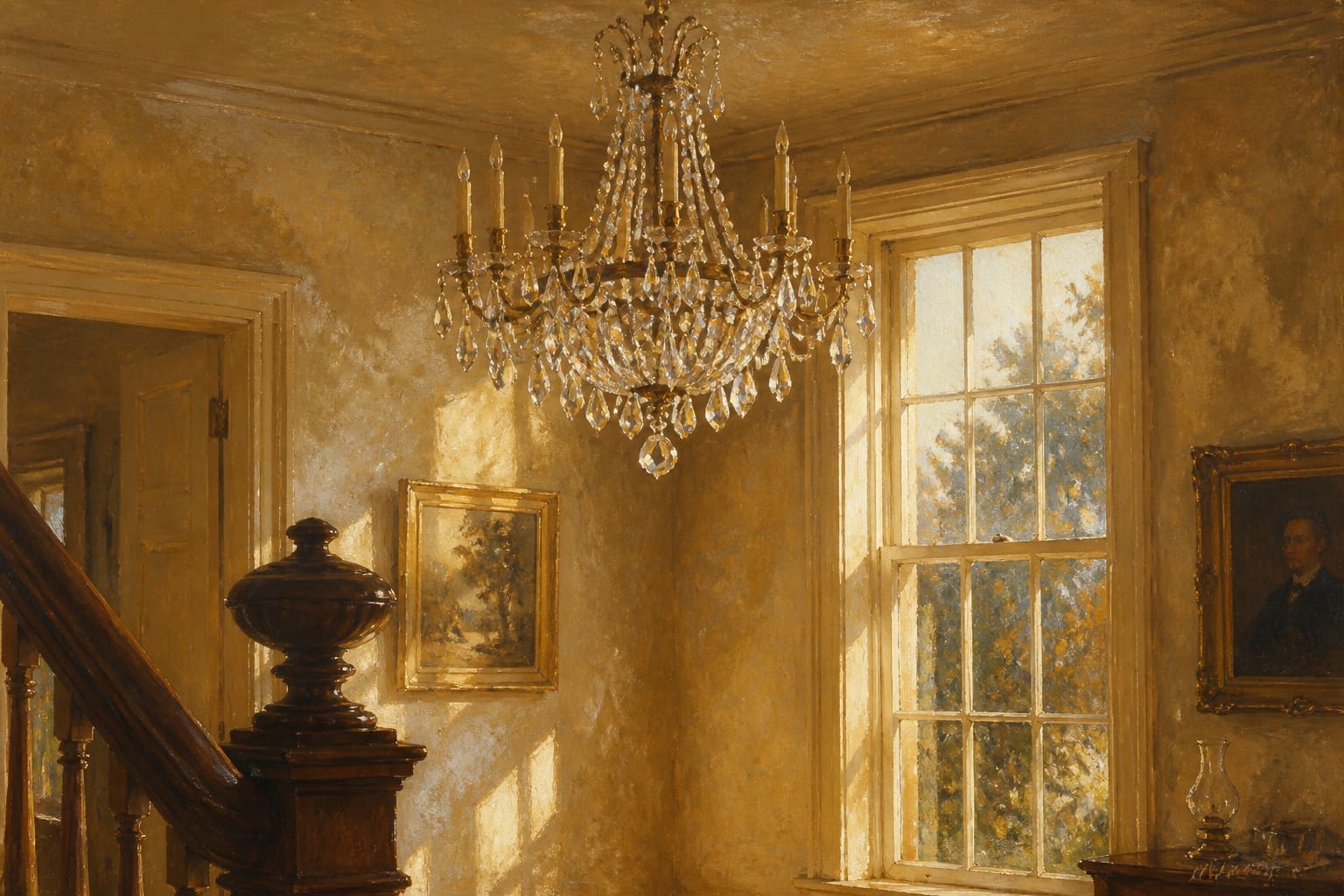
For about a hundred years, anyone who walked into the parlor of the Bradford-Berry House looked up and saw something they would not have expected on the Cumberland frontier.
Crystal chandeliers. From Paris. Catching afternoon light in a brick farmhouse on Drake’s Creek.
They are not there anymore. Sometime during the long decline of the late twentieth century—when the property had slipped out of family hands and the structure sat for years without anyone watching it closely—the chandeliers disappeared from the rooms they had lit since the 1850s. The exact circumstances were never recorded. What we have left is the record itself: period documentation, oral histories from neighbors and Berry descendants, archive photographs, and the consistent testimony of people who knew the house in its better years. They were here. They are part of the story even if they are no longer part of the room.
The Pullman Company staircase that came a generation later is still in place—though it, too, has paid a price for the years of neglect. It needs restoration of its own. But it is here, and that is no small thing.
The chandeliers were installed sometime in the 1850s, when the house was already more than half a century old. By then the Bradford era had given way to a long stretch of changes in ownership and stewardship, and one of those families—we know their order from sales records and gravestones, but not always their interior decisions—decided that the building deserved better light. Specifically, French light.
It was an extraordinary thing to do. Paris crystal in the 1850s was not the kind of object you ordered from a regional warehouse. It was lifted off a transatlantic ship, transferred to a riverboat, hauled overland by wagon, and finally raised, pane by pane, into the parlor of a brick house ringed by fields. The economics of getting it there are almost as fascinating as the chandeliers themselves. Someone wanted those crystals badly enough to pay the freight—and to take the risk that they might not survive the trip.
They did survive that journey. They lit the parlor for roughly a hundred years afterward.
About forty years later, around the 1890s, the house got its second great upgrade: a massive front staircase, built and shipped by the Pullman Palace Car Company.
If the chandeliers were a flourish, the staircase was a statement. Pullman is best known for its sleeper cars—the polished, paneled, brass-fitted railroad coaches that defined American luxury travel in the late nineteenth century. The same craftsmen who built those cars built furniture and fittings on commission for private clients with the budget to commission them. A Pullman staircase in a house meant that someone with serious money, serious taste, and serious connections decided this entrance deserved the same hand that built the most famous sleeper cars in America.
The combination tells us something about how the Bradford-Berry House was understood by the people who lived in it.
It was never just a farmhouse. From the moment it was built, the structure was meant to make a statement about the family inside it—two-foot brick walls, native limestone foundation, a basement big enough for serious household work. As the decades passed and Hendersonville grew up around the homestead, each generation had a chance to add its own statement. The chandeliers were one. The Pullman staircase was another. Even Sarah Berry, who became the property’s owner in 1887 as a newborn, started renovating it in the early twentieth century—adding a garage, a kitchen wing, and an elevator before her plans paused.
These are upgrades that tell a particular kind of story. Each one was a bet that the house would still be there in a hundred years to enjoy them.
That bet has paid off, in part. The Pullman staircase is still in the entry hall. It is battered. It needs work. It is hand-carved by a company that no longer exists, mounted in a house that came within a generation of being lost, and it is exactly the kind of object that does not get replaced when it disappears. The brick walls are still two feet thick. The native limestone foundation is still doing what frontier masons asked it to do. Walking through the rooms is like reading a stratigraphy: 1790s brick on the outside, 1890s American craftsmanship under your feet—worn, scarred, waiting for restoration—and a long century of wear and care layered on top of everything.
But the chandeliers are gone. And their absence is its own kind of historical document. They survived a transatlantic crossing, a riverboat ride, an overland wagon haul, and roughly a hundred years of Tennessee weather. They did not survive a stretch of years when no one was watching. That is the precise lesson of preservation—the part the brick walls cannot teach on their own.
When the preservation society talks about saving the Bradford-Berry House, this is part of what we mean. The structure is not the only artifact. The staircase is an artifact—and it needs help. The choices that brought the chandeliers here, and the choices that let them slip away, are part of the historical record. Lose the building, and you do not just lose the walls. You lose what is left of the long quiet conversation between everyone who ever decided this place was worth investing in.
For National Historic Preservation Month, that is worth dwelling on. The Bradfords built something durable. The families who came after them made it beautiful. Some of what they made is still here, waiting for restoration. Some of it is not. Both lessons matter. Both are part of what the next chapter has to carry forward.
Frequently Asked Questions
What were the chandeliers in the Bradford-Berry House?
The Bradford-Berry House parlor held crystal chandeliers shipped from Paris and installed in the 1850s; they hung for about a century before disappearing during the house’s late-twentieth-century decline.
What is the Pullman staircase in the Bradford-Berry House?
Around the 1890s, the Bradford-Berry House received a grand front staircase built by the Pullman Palace Car Company, famous for its railroad sleeper cars; the staircase still stands in the entry hall and awaits restoration.
How were the Paris chandeliers brought to Tennessee?
The crystal traveled by transatlantic ship, then riverboat, then overland by wagon before being raised pane by pane into the Bradford-Berry House parlor.


